

Five-Time Grammy Award Winner Angélique Kidjo: ‘We Have to Protect Hope’
October 09, 2026
At ARHU Dean’s Lecture Series, the musician discussed the power of expression, language and staying hopeful.
By Jessica Weiss ’05
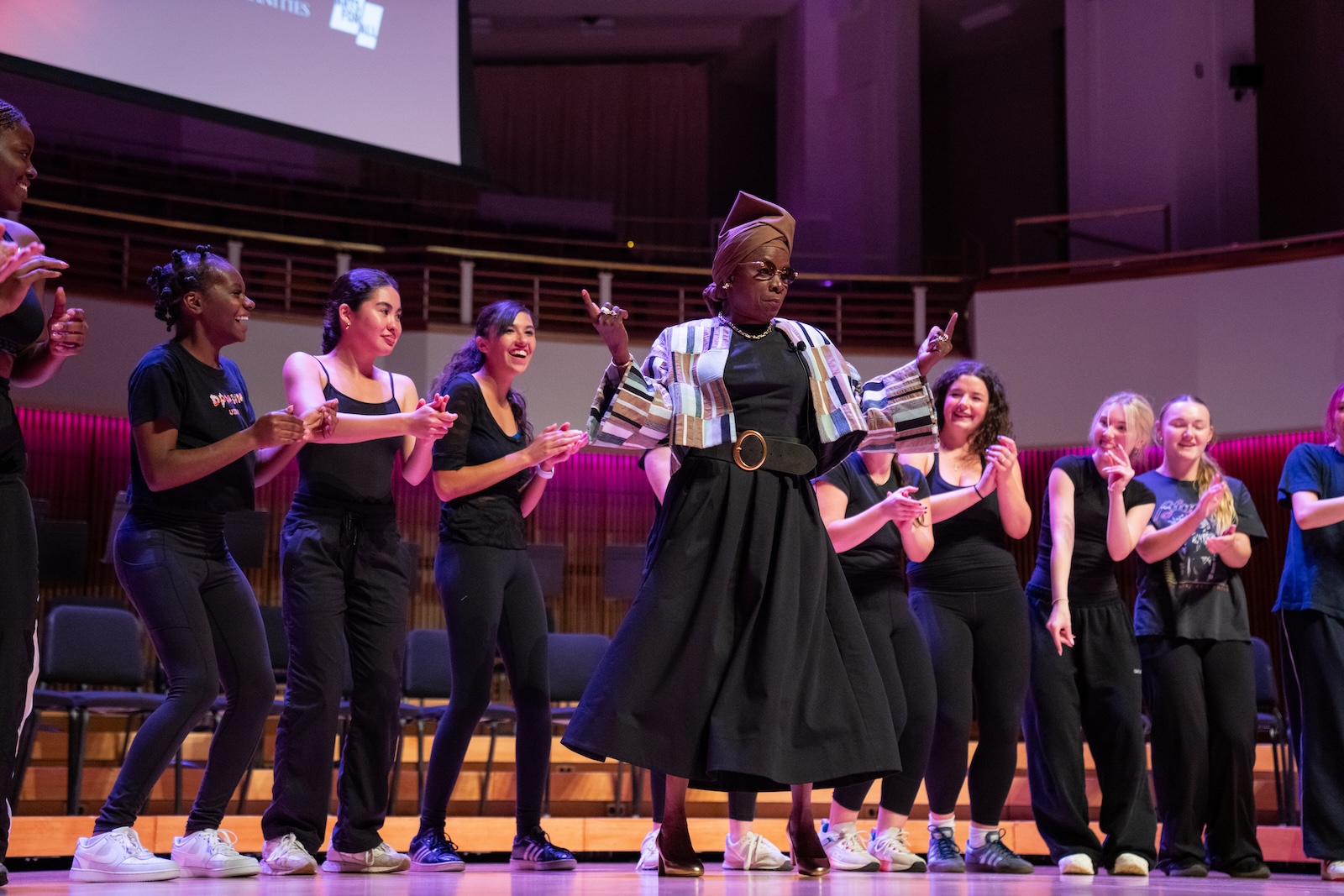
Beninese musician Angélique Kidjo swayed in her chair as 15 undergraduate dancers moved across the stage of The Clarice’s Dekelboum Concert Hall to the rhythms of her song “Bando.”
For a few minutes on Monday night, the five-time Grammy Award winner took it all in, admiring the choreography created by Ama Law ’08, M.F.A. ’19, artist-in-residence in the School of Theatre, Dance, and Performance Studies.
Then she couldn’t contain herself.
Kidjo rose to her feet and joined in, dancing and singing for several joyful minutes as the audience erupted in cheers. It was a fitting end to an evening with an artist whose music — and generous spirit — have carried her to stages around the world.
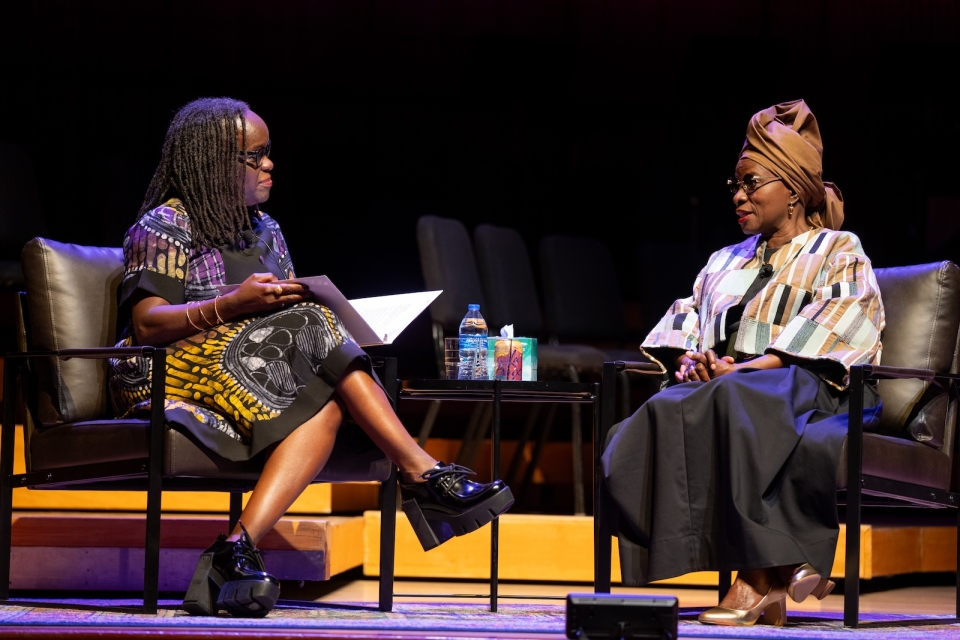
Kidjo joined College of Arts and Humanities Dean Stephanie Shonekan for the latest installment of the ARHU Dean’s Lecture Series, in a conversation about music, freedom, language, identity and the importance of holding onto hope in difficult times. The event was co-sponsored by Arts for All, and also included a performance of Kidjo’s “Malaïka” by the UMD Symphony Orchestra, featuring vocalist Hannah Jackson, an M.A. student in musicology.
One of the most celebrated African musicians of her generation, Kidjo has released 18 albums and collaborated with artists including Philip Glass, Yo-Yo Ma, Alicia Keys, Pharell Williams, Carlos Santana, Sting, Burna Boy, and John Legend. She has performed at Carnegie Hall, the Vatican, the United Nations and major events including the Olympics and World Cup. In August, she became the first Black African artist to receive a star on the Hollywood Walk of Fame.
Shonekan also found common ground with her guest: Both were born and raised in West Africa, grew up under military dictatorships, share a love of Yoruba music and, as Shonekan noted, “love a good head wrap.”
Here are a few lessons Kidjo shared from her decades of making music, asking questions and speaking her mind:
Freedom is at the center of art.
Kidjo was just 12 years old when a military coup transformed life in Benin. Almost overnight, she recalled, the “open door” house where she grew up — where visitors were always welcomed into conversation — became shrouded by fear. Her father warned his children that anyone entering their home could potentially pose a danger. Kidjo had been raised to ask questions and speak freely, but suddenly she had to watch what she said.
Losing that freedom made her realize the importance of it: “Without freedom, you don’t have a society,” Kidjo said. “Freedom is at the center of art.”
Whether through music, painting, writing or poetry, she said, artists tell stories that allow people to understand one another and imagine different possibilities. That cannot be taken for granted.
“We are each other’s storytellers. We are each other’s keepers,” she said. “If we want to be still on this planet for generations to come, we need to do everything we can to protect the arts and to fight for our freedom.”
Language is a way of understanding other people — but also yourself.
Kidjo speaks five languages and sings in even more, which she traces partly to growing up in West Africa, where even neighboring villages may speak different languages. But for her, learning languages has never been just about communication.
“Understanding people can allow me to understand myself,” she said. “And to question myself all the time.”
As a child, Kidjo questioned why she was learning African history through books in English rather than studying African languages and accounts produced by Africans themselves. Years later, a conversation with economist Jeffrey Sachs about who gets to narrate Africa crystallized something for her: “It’s not up to us to tell your story,” she recalled him saying. “You have to do it yourself.”
For Kidjo, music became one way of doing that. She sees little separation between music and language. After all, both depend on tone and rhythm: “Music is language,” Kidjo said.
Know yourself — and don’t let other people define your art.
Early in Kidjo’s international career, she made one demand before signing a recording contract: She would get to choose the type of music she made.
“I don’t want anybody to tell me what I gotta do,” she recalled telling Island Records founder Chris Blackwell.
Kidjo had already encountered narrow ideas of what an African artist was supposed to look and sound like. During a photo shoot for her first album, a stylist asked why she was being called in to style an African. “‘Don’t they walk naked in their countries?’” Kidjo recalled her saying.
The experience forced her to ask herself a set of questions that would guide the rest of her career: “Which story do you want to tell? Who are you? What kind of artist do you want to be? Where do you want to go?”
“I wanted to make sure that my identity would be kept,” she said, “because I cannot be somebody else. You only can give what you are.”
That same commitment to authenticity shapes how Kidjo approaches performing. Connecting with an audience, she said, requires making herself vulnerable rather than holding anything back.
“Before you step on the stage, you have to be ready to be naked spiritually,” she said. “In that vulnerability, on stage, that’s when there’s community.”
Hope is something we have to protect.
Kidjo’s latest album, “Hope!!,” took five years to make and is deeply connected to her mother, who died in 2021. Growing up, Kidjo said, hope was her mother’s “magic word.” Raising 10 children, she taught them to be kind and insisted that tomorrow could always be better, even amidst profound loss. Kidjo has carried that philosophy with her throughout her own life.
“We are born with hope. We are born with joy. We are born with empathy, compassion, love,” she said. “You choose which path you want to walk.”
That choice can feel especially difficult now, she said. But even “in chaos, there’s hope,” she said. “We have to protect it.”
Kidjo said the message feels particularly urgent when she thinks about young people, including her own daughter, who once told her mom she felt she had to mourn the world that was promised to her.
Adults should be humble and listen to young people, Kidjo said, and help them build a world they want to live in.
“Let’s use art, use philosophy, use science, anything we have,” she said. “Let’s push them to be the better example of us.”
Photos by Taneen Momeni.