Prof. Donahue-Shipp led Paint on Site Project
Prof. Donahue-Shipp led Paint on Site project with his ARTT 426 class


The School of Theatre, Dance, and Performance Studies values the unique power of the performing arts to address social issues through performance practice and research.
We value active discourse, focused discipline, rigorous inquiry and collaborative thinking to creatively express and embrace difference, diversity and identity. We train artist-scholars to be active leaders who influence and expand the practice and social impact of theatre, dance and performance studies.
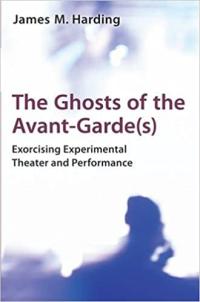
The Ghosts of the Avant-Garde(s) offers a strikingly new perspective on key controversies and debates within avant-garde studies, arguing for the importance of reopening pivotal controversies and debates in avant-garde studies and challenging pronouncements of the “death of the avant-garde” that tend to obscure the diversity and plurality of avant-garde gesture and expression.
James M. Harding revisits iconic sites of early 20th-century performance to examine how European avant-gardists attempted—unsuccessfully—to employ that discourse as a strategy for enforcing uniformity among a politically and culturally diverse group of artists. He then takes aim at historical and aesthetic categories that have promoted a restrictive history and theory of the avant-garde and narrow readings of avant-garde performance. Harding reveals the Eurocentric undercurrents that underlie these categories and urges a consideration of the global political dimensions of avant-garde gestures. His book will interest scholars of theater and performance, art history, and literary studies, as well as those interested in the relation of art to politics in various historical periods and cultures.
Read More about The Ghosts of the Avant-Garde(s): Exorcising Experimental Theater and Performance

Cutting Performances challenges four decades' worth of scholarship on the American avant-garde by offering a provocative reconceptualization of the history of avant-garde performance along feminist lines. Focusing on five women artists (Elsa von Freytag-Loringhoven, Gertrude Stein, Yoko Ono, Carolee Schneemann, and Valerie Solanas) whose performance aesthetics made prominent use of collage techniques, James M. Harding sheds light on the cultural history of the avant-garde and the role that experimental women artists played in that history. He investigates the prominent position that collage technique occupied within the artists' performance aesthetic, and the decisively feminist inflection that their work gives to collage as a mode of avant-garde expression. The radical juxtapositions in their works produce the powerful effects of making the familiar strange and establishing contexts from which new understandings may emerge.
Harding examines the performative dimensions of collage in experimental, feminist redefinitions of the literary, graphic, and theatrical arts, filling a void in a scholarly discourse that, while ostensibly about the vanguard, has lagged well behind other significant theoretical and historiographical currents. Cutting Performances not only challenges assumptions that have governed scholarship on the American avant-garde but also establishes a context to rethink the history of American avant-garde performance along feminist lines. It will appeal to audiences interested in theater history and performance studies as well as those interested in the cultural history of the avant-garde and the role that feminist experimental artists have played in it.
Few individuals have positioned their work more controversially or consequently than Richard Schechner within the pivotal debates that define Performance Studies. The Rise of Performance Studies is the first collection of essays to critically examine the profound contributions that Schechner has made to Performance Studies as a discipline.
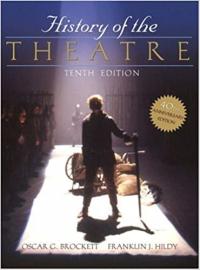
This 40th Anniversary Edition retains all of the traditional features that have made History of the Theatre the most successful text of its kind, including worldwide coverage, more than 530 photos and illustrations, useful maps, and the expertise of Oscar G. Brockett and Franklin J. Hildy, two of the most widely respected theatre historians in the field. As with every edition, the text reflects the current state of knowledge and brings the history of theatre up to the present. This tenth edition continues to provide the most thorough and accurate assessment of theatre history available.
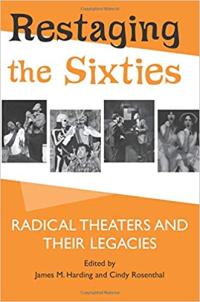
In the volatile period of the late sixties and early seventies, several theater groups came to prominence in the United States, informing and shaping activist theater as we know it today. Restaging the Sixties examines the artistry, politics, and legacies of eight radical collectives: the Living Theatre, the Open Theatre, the Performance Group, the San Francisco Mime Troupe, El Teatro Campesino, At the Foot of the Mountain, the Free Southern Theater, and Bread and Puppet Theater. Each of the specially commissioned essays is from a leading theater artist, critic, or scholar. The essays follow a three-part structure that first provides a historical overview of each group’s work, then an exploration of the group’s significant contributions to political theater, and finally, the legacy of those contributions.
The volume explores how creations such as the Living Theatre's Paradise Now and the Performance Group’s Dionysus in 69 overlapped with political interests that, in the late 1960s, highlighted the notion of social collectives as a radical alternative to mainstream society. Situating theatrical practice within this socio-political context, the book considers how radical theaters sought to redefine the relationship between theater and political activism, and how, as a result, they challenged the foundations of theater itself.
Read More about Restaging the Sixties: Radical Theaters and Their Legacies
The essays in this collection offer a radical reappraisal of the avant-garde by placing it within a much broader global context. The book questions the very assumptions that underlie the generally accepted chronology and theory of the avant-garde, and offer a bold new performance-based theory that moves beyond Eurocentric presup-positions. In ten essays especially commissioned for this volume, leading scholars and critics including Marvin Carlson, Supito Chatterjee, John Conteh-Morgan, Harry J. Elam, Jr., Joachim Fiebach, David G. Goodman, Jean Graham-Jones, Hanna Higgins, and Adam Versenyi discuss avant-garde performances in Africa, the Middle East, Mexico, Argentina, India, and Japan.
Although the canon of modern and contemporary drama would be difficult to imagine without the influential legacy of the movements and strands of the historical avant-garde, this critical history is often overlooked in courses on modern and contemporary drama and theater.
Though primarily focusing on issues of textuality and performance, the essays regard the antitextualism of the avant-garde as indicative of the wide variety of anti-cultural sentiments that have characterized avant-garde performance. The volume begins with the anti-textual sentiments of the avant-garde, then offers antitextual models, explores specific performances, and ends with a critical analysis of the avant-garde. Uniting the array of opinions articulated is a belief that despite the problems that haunt the traditions of avant-garde theater, it can nonetheless offer continued valuable insights into the industries of literature, theater, scholarship, and culture.
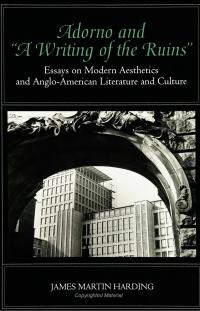
Arguing that postmodernism has so shifted current critical paradigms that Adorno's work can best be assessed in terms of its relevance in specific localized contexts, this book pursues a course that preserves Adorno's opposition to hegemonic programs but that is also wary of Adorno's own (negative) penchant for totalizing concepts. Unlike recent works which attempt to synthesize Adorno's writings into a comprehensive system that then becomes either the focus of an overriding critique or an object of appropriation, Harding orders his book as a collection of essays whose loose association questions the structural totality of Adorno's thought. Though together the essays cover all the major issues of Adorno's thought and offer a wide critical survey of his writings, the diversity of their focus avoids a systematic reduction of Adorno's work into a reproducible technique or method. The result of this strategy is a far more dynamic analysis of Adorno than a mere critical reconstruction of his ideas.
By applying Adorno's theories to works by Samuel Beckett, T.S. Eliot, Ralph Ellison, and Amiri Baraka, the book pushes critical discussion of Adorno into cultural contexts that, while perhaps new for Adorno scholars, reach out to those whose knowledge of Adorno is limited. This book is a fine introduction to the subtleties of Adorno's writing and a genuine contribution to Adorno scholarship.